Thursday, February 28, 2008

(Yikes Again)! My Spring Quarter Class Schedule!

Spring quarter I will be taking slightly fewer credits than I took in fall (29) and winter (26.5), however, the classes are supposed to be quite challenging and I have a feeling they spring will be just as time consuming as my previous quarter. Here is the scary list:

HUBIO 532: Nervous System (8 Credits)
An integrated approach to the normal structure and function of the nervous system, including the eye. Presents neuropathological examples as well as clinical manifestations of neurological disease.

HUBIO 534:
Microbiology and Infectious Disease (9 Credits)

An introduction to medical microbiology and infectious diseases. Emphasizes the biology of microbial pathogens and the mechanisms of pathogenesis. Covers clinical manifestations, epidemiology, general principles of diagnosis, therapy, and prevention of infectious disease.

HUBIO 535: Introduction to Clinical Medicine (4 Credits)
Adult screening physical examination is taught through the use of lecture, audiovisual aids, and small-group tutorial, where students in supervised setting practice the physical examination on one other. Further practice in the performance and recording of the patient profile and medical history.

MED 561: Tropical Medicine (1 Credit)
Intended for professional health science students interested in learning the pathophysiology, epidemiology, and clinical presentation of disease conditions that re more commonly seen in less-developed countries, resource-limited settings, or tropical climates, and how to diagnose, treat, and follow the resolution of these diseases with commonly limited resources.

PATH 521: Anatomy and Autopsy (1 Credit)
Students view an autopsy, and learn how autopsy can diagnose disease, determine cause of death, and improve patient care. Requirements include orientation session, autopsy, and a Clinical-Autopsy conference. Participants must be free at least one morning per week to attend an autopsy at UWMC. UW medical students only.

MED 505: Preceptorship in Medicine (1 Credit)
To provide opportunity for first- and second-year medical students to gain personal experience with medical practice situations by being stationed with carefully selected clinical faculty members in their offices.


If my calculations are correct it is going to be 24 Credits for spring quarter. Although it will be daunting (last year 17 students failed microbiology, so I guess it is really hard), I am actually really looking forward to my classes in spring. The majority of our time will be spent learning Neurobiology and Microbiology which are some of my favorite subjects. I did my undergraduate degree in Neurobiology and I am interested in going into Infectious Disease with my medical education. Also in spring we get to learn our physical exam skills which should be extremely fun as well. I am excited about getting to take an elective in Tropical Medicine right before traveling to Uganda and working in a hospital in Kampala. Hopefully I will actually get to put some of my new knowledge to use while I am there!

Monday, February 25, 2008

Is a pediatrics residency in my future????

Last night instead of studying like I should have, I took the AMA specialty match questionnaire (it asks you 130 questions about your personality and preferences in medicine and then tells you which medical specialty would be the best match of you). A waste of time, I know, particularly as it is at least 2 and a half years before I even need to think about which residency/specialty I would like to go into. However, procrastinating is so much fun when you should be doing something (for example, studying for 4 final exams), but are doing something that you don't need to do for over two years. Anyway, the specialty match thing said the #1 match for me would be Pediatrics. My number #2-8 matches were all the Oncology sub-specialties (go figure!), #9 was Anesthesiology, and #10 was Infectious Diseases.

One of my instructors of the Kenya course I took in 2007 told me I should study specialize in pediatric infectious disease so that I could come back to Kenya and help improve the treatment children who are living with AIDS and Tuberculosis. (The current standard for treating children with infectious diseases in East Africa appears to be quite dismal). Oh well... we will see.

Kids are so darn cute! (This is a picture of my little sister Monica showing off her ballet skills). At the last Saturday clinic with my preceptor a little 2 year old Ethiopian girl gave me one of her Winnie the Pooh stickers that she had received from the nurse. It was really sweet. I thought for a while, "Yeah, I think I could really enjoy taking care of children."


You all have seen this picture before - a picture of me and a child from the Potika IDP camp in Uganda. Are more infectious refugee children in my future? Only time will tell.

Preceptorships are the BEST THINGS EVER!!!

I have to admit - I am not a huge fan of the whole sitting in class for 7-8 hours a day (Tuesdays and Thursdays) or 4-5 hours a day (Mondays, Wednesdays and Fridays) and then studying more when you get home thing. It is getting a little bit old. How do I with stand the practically unbearable monotony? How do I keep my sanity in the sea of memorization? The answer is remembering why I am putting myself through all of this. When do we do this? During our preceptorship.

My preceptor is AMAZING. She is so cool and laid back, yet also really knowledgeable and eager to see me learn and observe new stuff. When I requested a family medicine preceptorship for winter quarter I asked if I could get a preceptor who works with disadvantaged populations. My desire was completely fulfilled. Dr. Huntington works in a clinic that does not refuse service to anyone even if they can't pay. Therefore the majority of their patients are on Medicare, Medicaid, DSHS, or are seen for free. I would say that we use a translator on about 1/2 of our clinic visits and a large population that the clinic serves is Ethiopian and Somali immigrants. They have a phone translator system and sometimes they have a translator that comes in-person with the patient. Dr. Huntington is particularly good at trying to bridge cross-cultural issues and asking the patient what they think is causing their symptoms.

I got also got to come into the clinic with Dr. Huntington on two Saturdays where she sees children who can't come during the week. I think the children are particularly fun. My nonexistent clinical skills have increased exponentially and I have been able to listen to heart and lungs on each patient, look in some children's ears and take a lot of medical histories. During the last Saturday peds clinic Dr. Huntington had me paint fluoride on the children's teeth for her. Apparently, a lot of poor children don't go to the dentist and are at risk for cavities, so there is a push among primary care providers who care for children to do this fluoride paint to prevent cavities.


This is a picture of me with my preceptor, Dr. Huntington. As noted above she is totally amazing. she is very caring and does all she can to make sure that her patients get the best possible care.

Thursday, February 21, 2008

Another use for Wilbur - suture workshop

Today was a really fun day in medical school. I got to practice sutures for the very first time! The Emergency Medicine Interest Group (a student organization of medical students interested in emergency medicine) put on a suture workshop. It was open to all medical students and filled up quickly because many students are quite interested in learning clinical skills such as suturing.

Two experienced ER doctors, one right handed and one left handed, gave an introductory talk about sutures and demonstrated how to make a basic suture. Then they handed out a pig's foot to each student and we made a cut with a scalpel into the foot and then tried to suture the gash close again. It was really fun. It actually felt like we were in medical school.


Ahhhh... Wilbur (or at least a pig that looks like Wilbur) the heroic star of the book, Charlotte's Web. The spider, Charlotte, works to save Wilbur from being butchered and eaten by writing phrases such as "Some Pig" in her web above Wilbur's pen. Little did Charlotte know that there was another use for Wilbur that had nothing to do with bacon for breakfast - suture workshop. I guess if Wilbur did have to die, we might as well use his feet for something. (Image from a Google image search).


Just in case you all are interested in learning a little bit more about suturing, I thought I would inform you of some of the basics that I was not fully aware of before last night. First of all, the suture needle is curved. This shape makes the circular movement of placing a suture easier to accomplish. Secondly, the suture needle does not have an eye, but the need is continuous with the suture thread. Thirdly, you don't hold the suture needle with your fingers, but in a medical version of mini-vice grips called hemostats or needle driver (or something like that). The hemostats have little handles like a pair of scissors, but you don't actually hold them like a pair of scissors. If you have large hands (ie you are a man) you hold the hemostats as shown in the picture below. However, if you are a girl or if you have smaller hands you actually hold the hemostats closer to the tip sort-of like a pencil. (The general idea is to just get better control of the needle than you would by grasping the handles alone).

How to hold the needle driver/hemostats if you have large hands. Correction - you would, of course, be wearing gloves if you were really about to suture up a human (or a dead pig's foot).

The placing of the suture is a little bit tricky - the main challenge is to try to get everything even. I still don't have this down, but hopefully it will come with time. Once you have the placed the stitch, you tie a knot. Below are the directions that came with our handout. (Just in case you are interested). You wrap the long end of the suture thread around the tip of your hemostats twice. Then you use the needle driver to grasp the short end of the suture (on the other side of the cut) and pull it through the loop you have just made. You pull this knot flat over the cut and then wrap the end of the suture thread around your hemostats the opposite direction and once again pull the short end through the loop. You repeat this many times, each time wrapping the suture thread the opposite direction as the time before. Then you cut the long end and you are ready to start the next suture. Pictures below to illustrate. This was meant for interest purposes only. Please don't try this at home. Thanks.


Monday, February 4, 2008

Sweet! I am going back to Uganda in the summer of 2008

Today I found out that I will be going to Uganda for 10 weeks in the summer of 2008. Isn't that awesome? The University of Washington Department of Global Health runs the International Health Opportunities Program (IHOP for short) every summer. The program accepts 10 students each year who are between their first and second year of medical school. The 10 students who are selected are sent to 5 different countries (2 students at each location): India, Madagascar, Peru, Palau, and usually Kenya. The program gives the selected students $5,000 each for airline tickets and to help pay for living expenses while in the country. To apply students fill out an application listing experiences, career goals and the languages you have experience with. You also have to get letters of recommendation from faculty members and then you have an interview.

I listed Kenya as my first choice location for obvious reasons. (Previous experience in Nairobi and elsewhere in Kenya, some experience with Swahili, and a draw towards that part of the world). However, due to the recent violence related to the elections in Kenya and the consequent travel warnings for US citizens, they decided to switch the Kenya site to Uganda.

We still don't have the full details about what we will be doing in Uganda, because it is a backup site some of the details are still being ironed out. However, it is known that we will be working in the capital of Uganda, Kampala, and that we will be at one of the city's larger universities. I also know that I am supposed to going with a girl who is a first year medical student from Idaho. (She is WWAMI student currently doing her first year of medical school in Idaho so I haven't met her yet). We will get to meet during the IHOP orientation in March.


This is a map of Uganda I found on a Google Image search. Kampala isn't really marked that well on the map, but it is just north of Lake Victoria. (On the map you can also see Kitgum which is where I worked when I was volunteering with Working to Empower in 2007).


This is the flag of Uganda. I hate to say it, but I think the flag is just a touch on the less attractive side. Kenya has the coolest flag ever and Tanzania's flag is really nice too, but Uganda's... I don't know. I once accidentally insulted a Ugandan by asking who decided to put the chicken in the center of the flag. I was severely reprimanded and it was explained that the bird on the flag is actually a very special crane. Perhaps when I go to Uganda this summer I will get the full story on the flag, learn to love it and will be eager to explain to all I meet about the Ugandan Crane.

Thursday, January 31, 2008

Dinner with Andrea

Once again, I force a boring update about my life upon you. However, I thought it would be good to report every once in a while that I occasionally do things other than study and feel overwhelmed.

On Wednesday I had the pleasure of meeting one of my long time friends, Andrea, for dinner. Andrea and I did the neurobiology program together during undergrad. We were lab partners during the first year of the neurobiology program and then we continued to work together throughout the program. We became good friends, in part because of our similar interest in working internationally and in public health. During our senior year I decided to get my Master's in Public Health in International Health and Development from Tulane, while Andrea decided to go straight into medical school at the UW, but still focus her carrier on international health.

Andrea is now a third year medical student at the UW and a wellspring of medical school knowledge and wisdom. She did the IHOP (International Health Opportunities Program) between her first and second year of medical school. She went to southern India and assisted in a hospital program working on the prevention of mother to child transmission of HIV. She is also doing the School of Medicine Global Health Pathway (discussed in a previous blog post). Andrea has also been fighting tooth and nail to get a combined MD/MPH program at the UW School of Medicine. She, and some other students, have made progress towards this goal, but not enough to make it as practical as most other MD/MPH programs. The big name schools that have both a medical school and a school of public health have a combined MD/MPH program (Havard, Tulane, Johns Hopkins, etc.) that is only one additional year over the normal 4 years of medical school. However, the UW School of Public Health insists that medical students must take an additional 2 years to get their MPH. Also, the UW School of Public Health is ULTRA snobby and only takes a few students each year who they believe are worthy to study public health. Therefore, most UW med students who want to get an MPH usually take a leave of absence and just go to Harvard for year to get their MPH (an MPH from Harvard probably looks better on your resume anyway). Anyway, I am glad that I already have my MPH from Tulane so I don't have to deal with the UW school of public health nightmare.

It was really fun to meet with Andrea. It is great that we are finally at the same school again. I am hoping to do the IHOP program (this summer) as well, but I haven't heard back about my application yet.


This is a picture of me and Andrea after dinner. Andrea is on the right.


Thursday, January 17, 2008

Sweet! Only 1,233 days until I'm a doctor!

I found this fun countdown thing so I decided to approximate when I will graduate with my MD degree. This year the medical school graduate ceremony is going to be on the first Saturday of June. If they hold it on the same day in 2011 (the year I am scheduled to graduate) then it is only 1,233 days from today until I graduate. Sweet! It still feels like a long time from now. (particularly on days like today when we had 8 hours of class)! Also, if something happens and I have to expand it will be a year later when I graduate. Of course, there is always the possibility of flunking out too. We will see.

“Psst! Turn your Stethoscope Around!”

The “Clue-O-Meter” has many different readings. Just a few of the possibilities are: “Stills needs some guidance, but has the big picture” “Generally out to lunch, but occasionally has moments of understanding,” “Pretty clueless,” “Definition of clueless,” and “So completely clueless, that the Clue-O-Meter can’t even get a reading on how clueless this person is.” Unfortunately, at our stage in our medical educations, many of us are at the last of those Clue-O-Meter readings. In fact, it is my new found conviction that if our future patients could see us right now in our education, they would never come to us for medical advice and they would definitely never let us treat them.

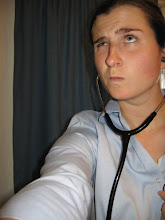
Allow me to demonstrate from my own experiences (and those of one of my friends) to refute the widespread belief that being in medical school equals intelligence and medical knowledge. Allow me to start with the basic tool of all of medicine and a physician’s best friend - the stethoscope. The earpieces of a stethoscope actually tilt in a certain direction. Please see the picture below. They are supposed to be worn so the earpieces point towards your nose. (So in the picture below, if I was wearing the stethoscope, my nose should be pointing towards my hand).


The School of Medicine alumni association generously gave us each a stethoscope at the beginning of fall quarter (previous pictures posted). However, many classmates and I haven’t really used them before in a practical setting. This quarter several of my friends and I are taking our very first preceptorship. We get to follow around a real doctor and get a taste for what we might be doing several years from now. It is so much fun (I am planning on posting more about my preceptorship in the future). At the end of my first morning with my preceptor she told me to bring my stethoscope next time. I was pretty excited, what was I going to be doing? The night before my next preceptorship I realized that I wasn’t exactly sure how to wear my stethoscope. I looked up the directions and discovered that the earpieces were supposed to point forward and I successfully listened to my own heart beat.

The first patient that morning was in for a health check and a referral. I was watching the visit with interest and suddenly my preceptor turns to me and says, “Great. Well Christine, why don’t you listen to this patient’s heart and lungs while I get this referral form?” Slightly startled, I said “OK” and approached the patient as my preceptor left the room.

(This is what I felt like as I approached the patient, although I tried to hide it in an appearance of calm)

He was an elderly gentleman and the lifted up the back of his shirt so I could listen to his lungs. He gave me a look of complete confidence and trust. I quickly put on my stethoscope (ensuring the earpieces were facing forward) and looked at the patient’s back with trepidation. I had never actually listened to someone’s lungs before. I thought back to anatomy and placed my stethoscope in the general vicinity of where I thought the left lung should be. It sounded sort-of like wind blowing through a tunnel. I figured I’d better move the stethoscope around a bit (like I had seen my preceptor do on an earlier patient). While I was doing this I thought to myself, “I am so totally faking this right now and this guy doesn’t have a clue that I have no idea what I am doing!” I also successfully listened to the patient’s heart and was finishing just as my preceptor stepped back into the office.

She looked over at me and asked, “So everything sounds good?” I said something like, “Well, um, it is my first time listening to the heart and lungs of a patient so I don’t really know what to listen for. But I think it might have maybe possibly sounded like what I would imagine good heart and lungs to sound like.” She said, “Well, if you aren’t sure, I guess I’d better listen then.” My internal reaction to this statement was “WHAT?” Apparently, if I had said that I was completely sure this patient’s lungs and heart were fine, she wouldn’t have even listened to them. I think she had much more confidence in my skills than I did. She listened to the patient’s heart and lungs and determined that they were in great condition, so I guess it would have turned out fine anyway.

One of my friends who also just started his preceptorship had a similar experience, except he didn’t practice with his stethoscope the night before. Therefore when his preceptor told him to listen to the patient’s lungs, he put on his stethoscope on backwards (earpieces pointing towards the back of his head). He later described his extreme mortification when his preceptor whispered behind the patient’s back, “Psst! Turn your stethoscope around the other way.”

Now, you may be thinking, ‘Oh, that isn’t so bad.’ Unfortunately, my embarrassment does not end there. I must further display my lack of knowledge of medical instruments, by admitting my difficulties in trying to find the on/off switch on my Oto/Opthalmoscope. For Christmas, my grandpa, grandma, aunt, uncle and dad all generously pooled together some money to buy me an otoscope/throat (and eye) illuminator which is required for spring quarter when we start learning the physical exam. Last week I decided that I was going to get it out and experiment with it. I briefly considered reading the directions and then scoffed at the idea. I am a medical student after all, how hard could it be? When I first took it out of the case I tried to find the “on” switch, without much luck. Then I realized in a stroke of genius that it probably had to be charged before it could be turned on. I successfully managed to take it apart and place the base in the charger overnight.


(Ahhhh... Genius. You have to charge it before it will produce light)

The next evening I decided to try again to conquer my now charged otoscope and learn how to turn it on. It sounded so simple, and yet, the on/off switch still remained a mystery.


(My bewilderment as I tried to figure out how to turn on my otoscope).

Finally, after at least five minutes of additional experimentation, I found the elusive on/off switch. It was at the top of the handle. You had to push a green button and rotate a black ring about a quarter of a turn until the green button popped back into place. Intuitive? Not for me!

The on/off switch circled.


“On”


“Off”


At last, complete success – stethoscope correctly positioned and otoscope turned on. Whew. I have a bad feeling this is just the beginning of feeling cluelessness as I embark on many years of medical training. Will my future patients ever find know just how clueless I was during medical school? I hope not. (Although the fact that I am publishing this on a website available to any internet user does not bode well for hiding my ignorance. Hmm... Perhaps this blog entry will mysteriously disappear after a few months).


Saturday, January 5, 2008

Christmas Pictures/ Birding Rant

I had a really good time visiting friends and family over Christmas break. Here are just a few pictures from my travels. Not that you really want to see pictures from my various family gatherings, but for those foolish enough to continue to visit my lame blog site now that my life has become boring, I will force them upon you.

I visited two sets of grandparents over Christmas break as well as spending some time with my family in Camano Island.

We had Christmas morning at my Grandpa Stan and Grandma Lorie's house (aka Gramps and Grams) in northern California. Their house can be summed up in one word: Birds. Everything is about birds in that house. Pictures of birds, sculptures of birds, paintings of birds, books about birds, birding handbooks, windows to see birds out of, 10s of bird feeders so that birds will come to the yard, a basement to store bird seed in, spotting scopes and binoculars to see birds with, a coat rack to hold birding coats and hats, a driveway that holds a car so that they can go birding, etc. What is the reason for this bird mania? Gramps (aka 'doc') was a professor of ornithology at Humboldt State University for over three decades and he is pretty much as bird crazy as they get (but we love him for it)! After reading this, you may not be surprised to know that their Christmas tree is decorated primarily with bird Christmas ornaments. Gramps counted them one year. I think there were 120 bird ornaments then and there are probably more now. I have included a picture of the tree just to illustrate my point.

The bird ornament tree. Unfortunately, the top of the tree got cut off in the picture. What was topping the tree? Was it a star? Was it an angel? Nope. It was a bird, big surprise there. :)

This is Gramps after we all opened our presents on Christmas morning. He requested socks for Christmas and was satisfied. In his lap was his biggest present: Handbook of the Birds of the World volume whatever (or something like that). I love the fact that it is called a "Handbook" when the whole idea of a handbook is something that can fit in your hand, i.e. is small and concise so you can take it in the field with you. I don't think he will be taking that huge book out in the field with him.

Speaking of books, Gramps has actually written a book himself. I know, impressive isn't it? I know your mind is going wild right now with interest. Am I descended from a line of great writers? Is my grandfather's book perched at the top of the New York Times Best Seller list? You might even be wondering what the book is about. Is it a thriller novel? Perhaps a mystery? Memoirs from his travels to nearly all the continents in the world? I think that if you dig deep into the depths of your mind you can probably guess what the book is about.

Think....


Think harder....


You're getting there....


Yup! You guessed it! His book is about birds. It is called, "Northwestern California Birds" and it actually has some nice pictures and useful information (if you are an avid birder, that is). It has been a good retirement project for him. Every few years or so he starts revising it again between coordinating Christmas bird counts and the like. I think he recently finished the 3rd edition.

Don't get me wrong. I am poking this fun at birders, but I actually like birding myself. It can be fun, particularly if it is nice weather and the birds are big and easy to see. It is also a good way to get a little exercise, enjoy nature and socialize with friends. I have just never been completely off the deep end about birds. I have tried, believe me. I even took a birding class at the UW during my undergrad years. (When they asked, "Why are you taking this class?" My response was, "Because I want to be accepted by my family." It turns out that the professor of UW class was friends with my grandpa and wrote him a letter at the end of course to tell him that I had done well in the class, but that I missed a robin on the second field identification exam). However, the birding madness has never quite infected me like it has with the rest of the family. Oh well, I guess they still love me even if I am the mutant non bird crazy granddaughter.


After Christmas I went back up to Washington. Here is a picture of my mom back in Washington making one night's dinner for 14 people. Yup, we really did eat it all.


Before going to see Gramps and Gramps I was visiting Granny and Spiro in the Bay Area in California. Here is a picture of Granny and Spiro together. Aren't they cute?
Spiro and me.
Granny and me.
I thought this was pretty funny. My older brother, Aaron, is actually staying with Granny and Spiro while he starts a new job in San Jose so we were both there visiting Granny and Spiro together. Granny is ULTRA organized and she had a towel rack for Aaron and a towel rack for me both clearly labeled with post-it notes. Granny is a retired message therapist/counselor.


Here is Spiro. It was so much fun to spend time with him. He told me (and Aaron) about the Great Depression, about how he meet Granny and other fun stories. It was a blast.

Wednesday, January 2, 2008

:-( Tribal Violence in Kenya due to the Elections

You all might be interested in the following New York Times Article: "Mob Burns Church in Kenya Killing Dozens"
http://www.nytimes.com/2008/01/02/world/africa/02kenya.html?_r=1&th&emc=th&oref=slogin

While I was in Kenya, I spent a lot of time talking with Betty, the Kenyan cook at the house I stayed at in Nairobi. A lot of the time I would go out shopping with Betty for meat and produce and other times I would practice my Swahili skills with her. I also asked Betty to help me understand Kenya politics. Betty is from the Luo tribe which is the second largest tribe in Kenya. The Luo's primary rival tribe is the Kikuyu tribe which is the largest tribe in Kenya and the most powerful politically and economically. Apparently the root of the Kikuyu tribe's power goes back to colonial days when the colonizing British forces discovered that the Kikuyu tribe would do their will, even betray their fellow Africans, if they were paid well enough. Therefore the members of the Kikuyu tribe were placed in positions of leadership and were given the most fertile lands and the best jobs in exchanged for their allegiance to the British forces and their help controlling the other tribes. After Kenya gained independence from England, the Kikuyu still maintained a status of power and economic superiority over the other tribes. The current president, Kibaki, is from the Kikuyu tribe. According to Betty, he has used his place of power (being president) to give further opportunity and resources to the Kikuyu areas of Kenya while depriving the parts of Kenya inhabited by other tribes, particularly the Luo. This was even evident as we drove around Kenya as a part of our Tulane University class. We would be driving along a horrible bumpy road with huge potholes and all of the sudden reach a wonderfully smooth paved road with no potholes. Along the the road were some of the nicest schools I had seen in Kenya. I asked what part of Kenya we were going through and the driver told me it was the Kikuyu section of Kenya. Elsewhere in Kenya roads have not been worked on for decades and schools are in a shameless wreck.

This favoritism towards his own tribe in President Kibaki is viewed with loathing as corrupt behavior by a large portion of the Kenyan population. Many of the Kenyans I spoke to over the summer said that they were so excited for the next election when they could vote Kibaki out of office. However, many people said that he was so corrupt they expected him to try to cheat a win in the next election.

Now, there has been an election in Kenya and Kibaki won by a thread. Many people believe he cheated and President Kibaki is refusing to let an independent party come in and investigate the validity of the election results. I never advocate violence as the solution to a problem, but I definitely understand why people are rioting in the streets. They believe democracy has failed them and they are turning to violence as way of being heard by the world.