Sunday, November 22, 2009

Brrr. Cold weather

This last week we had some cold weather. It reached down to -10 to -15 degrees F. It was by far the coldest weather I have ever experienced in my whole life. It means a lot of dressing and undressing when you have to go outside throughout the day. We have a few inches of snow, but according to one of our classmates, it isn't enough to cross country ski in.


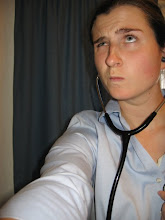
Here I am all bundled up. Good times. If you walk all the way to the hospital (about a 6 minute walk) when it is really cold outside, your nose hairs freeze and sometimes your eye lashes freeze.


This is the Alaska Magazine issue that was for sale when we first arrived in Anchorage. Apparently, what small birds and animals to shoot during the fall is a hot-selling topic.


I keep forgetting to go outside and take pictures during the daylight hours, but here is picture of the pathway between the University of Alaska Anchorage Housing (where we live) and the Student Commons area.

I will try to add more pictures later. So far I have been pretty bad about taking my camera with me when I go out.


So far, I am definitely having a positive experience. People have been really nice and I am learning a lot.

Tuesday, November 17, 2009

Don't bother voting in my lame poll

ORIGINAL POST:

To my blog readers, please vote in my poll about whether or not I should allow Google advertisements on this blog. I have been very resistant to it in the past - I didn't want to subject my blog readers to the unpleasant words of corrupt corporate America. However, I decided I should put out a poll to see how you all feel about it. What do you think? Are my witty words and stories strong enough to overcome the irritation of annoying advertisements (doubtful), or do you reject buckling under corporate powers for a couple of dollars every month? I would like to settle it all in a democratic vote (which is apparently going to be heavily favored towards those with more advanced computer literacy because you have to have a gmail account to vote in the poll). However, if you do not have a gmail account, feel free to leave an anonymous comment at the end of this entry and I will add it to the final tally.

Thanks!
Christy

_________________________________
UPDATE:
Apparently my poll is completely defective and I am the only one who has been able to vote in it so far. This was my first attempt at setting up a poll so I probably did something wrong, but it doesn't stop be from sending some bad thoughts towards Blogspot and Google. Sorry about the technical difficulties. Feel free to post comments if you have strong feelings either way.

Sunday, November 15, 2009

Baby Feet

The other night I had one of my first overnight labor and delivery shifts. It was a lot of fun and I had some very good and interesting learning opportunities. It turned out to be a fairly quiet night as far as labor and delivery usually goes. I took a woman down to get an ultrasound and then I ended up following a woman who was in labor. The woman delivered towards the end of the shift and the delivery needed a vacuum (attach suction device to baby's head so the OB can assist with the delivery). It was a good learning experience because I had not seen a vacuum delivery before. After the delivery the baby's family was very happy and crowding around the new infant and mom. After cleaning up a bit in the room, I was sitting at the nurse's station and a nurse was walking by and asked if I wanted to 'help make baby feet.' I knew that part of the post-birth paperwork was to create a paper image of the baby's feet using this weird powdered ink stuff, so I assumed that this is what we were going to end up doing on our newly delivered infant. Being my normal enthusiastic self, I said I would be delighted to help and jumped up to follow the nurse.

I made a visual illustration to emphasize what I thought we would be doing when 'making baby feet' before entering into the experience:

I followed the nurse into a room where we set up some tables and started getting out supplies. There were some bowls and materials to make a dough like substance and plaster. At first I was a little puzzled as we were getting the supplies out of a cupboard called "bereavement supplies," but in my sleep-deprived state, I didn't put any more energy towards thinking about the issue. The nurse explained that we were making two sets of baby feet by pressing the dough flat into the bowls, then we would press the baby's feet and hands into the dough to make and indentation, and then pour plaster over the dough to make an impression of the baby's feet. Then when the plaster was almost dry you could engrave the baby's birth date and name in the back. The nurse gave me a sad little smile and said it is a really nice thing to help the parents remember the baby by. It was then I realized through my sleepy haze, that no one had actually told me that we were 'making baby feet' on a living baby. I looked around the room a bit more and saw a carefully arranged pile of flannel Mickey Mouse baby blankets on the end of the bed. I quietly asked the nurse if she could tell me the story behind the baby. She explained that it was a baby that was born many weeks before the age of viability (age of viability is around 23-24 weeks gestational age) and there was no way they could save the baby. The nurse explained that many years ago, medical personnel thought that a woman should not see a child that was miscarried/stillborn, and that every one should just sort-of pretend that it never happened. However, now they have found that mothers/parents have better closure and actually heal better after the loss of a child if they have many different ways to remember the baby by - pictures, naming the child, a baby feet plaque, counseling, etc. So the hospital helps parents with the grieving process and remembering the baby in many ways including making baby feet impressions to give to the parents.

Even after having a couple minutes to prepare myself, I think my face still whitened a little when the nurse carefully brought over the pile of Mickey Mouse baby blankets and removed a very small dead baby. Using gloved hands she gently pressed the feet and hands into the dough, and then handed the baby to me. I was shaking a little as I held the cold body (it fit easily in one outstretched hand), but was able to repeat the process and create impressions in my bowl of dough as well. The nurse then carefully took the baby back and dressed him in some premature infant clothes and took him back to his parents for holding/pictures. Although it was a bit of an emotional experience, I felt very privileged to be part of it. I also think that it is an important point that when new parents experience a loss such as this, they want the existence and death of their child to be acknowledged. A very good lesson, but hopefully not one I will have to utilize frequently.

Wednesday, November 11, 2009

6minutes X10 = 1 hour

When we arrived, we were told that the sun sets 6 minutes earlier each day this time of year in Anchorage. At first we didn't think it sounded like much, then we realized: 6 minutes a day X 10 days = 1 hour! Every ten days we are here it gets dark 1 hour earlier! Yikes. So if it gets dark around 4:45pm when we first arrived, it is going to get dark around 3:45pm in just 10 days, etc. (Ok, sorry for saying the exact same thing 3 times). Apparently by the time we leave daylight will extend from around 10am to 2:30pm or something crazy like that. Fortunately the clinic I have been assigned to has lots of windows so I will get to see the sun for a little while each day.

I hope you all are well. If you live in an area with lots of sun now, soak up some rays for me!

Tuesday, November 10, 2009

Arriving in Alaska, quick update

I arrived in Anchorage on Saturday. The flight was fairly uneventful other than being an pretty sparsely populated plane and it seemed to have a slightly higher percentage of red-neck type personalities on board. I was slightly horrified to discover that the largest airport in the largest city in the entire state only had one baggage carousel. While waiting for my luggage, I discovered a well dressed and articulate man waiting for luggage. I took a chance and asked if he was a medical student. He was indeed a medical student who had taken time out to get his PhD, hence why I did not recognize him. We were taken to the University of Alaska Anchorage campus where were placed in the wrong apartment. After some more adventures and the arrival of our 3rd OB/GYN student (Lindsey), we found the correct room and moved all of our baggage. It snowed 3 inches on Sunday night and we were awoken frequently by the grinding of snow plows. Today they put the studded snow tires on our all-wheel-drive Subaru and we seem to be in pretty good shape as far as transport goes. Lindsey, one of the other girls on the OB rotation, used to be ambulance driver for 5 years and is really good in driving in all weather conditions. I have driven here once, but gladly defer to other more experienced snow drivers. Tonight it is 14 degrees F, but according to the weather report it feels like 5 degrees F. It stings a little when the air hits your face, but we have marveled at how little the natives seem to wear despite the chilly temperatures. We must seem like people visiting Seattle decked out in rain boots, rain coats, rain pants, and umbrellas when it is just slightly sprinkling.

Monday and today were both days of orientation to the OB/GYN rotation. Today we had a suture workshop where we practiced cutting and suturing up placentas and tying surgical knots. It was fun, but once again I was faced with the realization that I am coordination-challenged.

Everyone keeps asking, but, no, I have not seen Russia yet. :)

I will try to keep updating when I can. Lindsey and I saw a moose tonight, but I didn't have my camera with me, so I didn't get a picture! Better luck next time.

Friday, October 23, 2009

Dog Dash 10 K

Last week I was going to go visit my family, but they were all sick (probably with H1N1) with fevers up to 102F, vomiting/diarrhea, and cough. I decided that I didn't actually love my family enough to exchange a 1 day visit for a 10 days of swine-flu nastiness. So last Saturday I went to buy a new pair of exercise/running shoes. At the shoe store they had a place to sign up for the Dog Dash 10K. The trauma and body-aches of running the Beat the Bridge 8K were just distant enough in my memory for me to think that running the 10K Dog Dash sounded like fun. On an impulse decision I decided to sign up for it, and showed up bright eyed and bushy-tailed for the run the next morning. During the run, I decided that the 10K somehow completely defied the rules of physics - it felt AT LEAST 3 to 4 times longer than a 5 K. How is that possible? I was trying to decide during the race if it was because in the past I have always running with people and during the 10K I was running by myself, but in the end it didn't really matter. It is still a terrible thing to put your body through. I got an email about a week later saying that there was a picture available of me during the race. Here it is:


However, if the camera had been a James Bond x-ray camera that could see my thoughts at the time of the picture, the photograph may have looked a little more like this:


I find the phenomenon of running in organized events/races very odd. The entire race you can be thinking: "What an absolutely terrible experience. I will never never do that again." But then, somehow at the end of the race you get this rush of adrenaline and finish feeling great. Strangely at the finish line your twisted ego-boosted mind comes up with the thought, "That wasn't so bad. I could totally do that again and probably run longer." Then months later, the feeling at the end of the race is the only thing you remember and you stupidly sign up for another. A very strange phenomenon indeed. With this phenomenon in mind, I will say that I had fun time running the 10K dog dash and being a low-achieving jog-walk-runner I was pleased with by final average time being around a 9 minute mile. Perhaps after a suitable amount of time passes so I forget the body pain I experienced this week, I might run another race. We will see.

Friday, October 16, 2009

I goin' to Alaska!

Allow me to say the title of this blog in pictorial form:


Alaska now.


Alaska in a few weeks!


That is right! I am going to Alaska for 6 weeks for my Obstetrics and Gynecology rotation! I am really excited about it. I hope it will be loads of fun and that I get to help with the delivery of lots of babies (hopefully not rectangular shaped ones). Plus it is my first time going to Alaska. I will have to buy some warm clothes first!

The "UC." (The "Ultimate Christine")

During my first 2 years of medical school I lived with another medical student named Melissa. She is very close to her cousin, named Betsy, who lives in Seattle. Betsy came over to the house and did lots of activities with Melissa and me. In the Spring of 2009 Melissa graduated from medical school and moved far far away for residency. Betsy and I had a we-miss-Melissa-and-Jon (Melissa's boyfriend) pity party and decided we still wanted to be good friends and hang out together even though Melissa was no longer with us in the Seattle area.

A few weeks ago Betsy asked if I would teach her how to make a dish that I had made for her before and she had really enjoyed. I readily agreed and we had a fun time hanging out and cooking. It was during our cooking adventure that Betsy told me about her "UB" project. The "UB" is short for "Ultimate Betsy" and apparently what the UB project entails is envisioning the person you want to be and then taking concerted steps towards becoming that person. For example, Betsy informed me that the UB goes to yoga several times a week and runs several times a week. In addition, the UB is a cooks good healthy meals, and does countless other admirable activities. Betsy explained that the cooking lesson was her taking steps towards becoming the UB.


A picture of Betsy and Melissa on Melissa's graduation day. Betsy is on the left.


Several weeks ago I started my Family Medicine rotation at an amazing location. It is a community clinic and serves a wide variety of underserved, uninsured, and minority patients. I had been excited about doing my rotation there for months. On my first day in the clinic I discovered a huge portion of the patient population at the clinic speaks Spanish. There is a Spanish interpreter on site everyday. However, most of the providers speak Spanish very well and are able to communicate quite well without a need for the interpreter. I speak almost no Spanish, and at the end of my first day I in the clinic I had never wanted to speak Spanish so desperately in my entire life.

So of you may be a little puzzled as to why, if I want to work internationally and with under served populations, why I to this point speak almost no Spanish. It is a long story. However, it begins in my stubborn (and slightly rebellious) teenage years. Being home schooled, you are sometimes frustratingly limited to learning what one of your parents knows or what you are able to teach yourself from a book. My mom took Spanish in Junior High school, and explained that this was my high school foreign language learning option. I had spent a week in Honduras, and saw the value of learning Spanish as a second language. However, when I first stated that I wanted spend a significant part of my life overseas working with underserved populations and that I felt particularly drawn to sub-Saharan Africa, no less than 5 people came up to me and said something to the effect of, "Africa is so far away. You should just learn Spanish and work in Central and South America. Then you would be closer to the US and could come back more frequently." It happened so frequently, that it really started to get on my nerves. Being a generally non-confrontational person, instead of being angry or arguing, I just smiled and gave a non-committal response and then quietly vowed to myself never to learn another word of Spanish.

(I have just realized the next paragraph is completely unnecessary to the point of this blog entry, so please feel free to just skip it. Sorry for all the extraneous words. If I was a good writer and considerate to my blog readers, I would just delete the next paragraph, but I am neither of those things and it was a lot of work to type up the paragraph, so I am leaving it in).
---------------------------------------------------------------------------------
Thus my language learning journey began. I quickly discovered that I loved learning new languages and particularly I enjoyed learning about different cultures through the conduit of the language. When our family adopted the my two brothers from Russia, my mom and I borrowed the Learnables tapes from a friend, and together we learned ~500-1,000 words in Russian. Mostly just nouns and verbs, we didn't learn grammar or how to conjugate anything, but it made it easier once the boys arrived with their non-existent English skills. Years, later I have forgotten most of the Russian I learned, but if passe people speaking Russian on the street I can still pick out the occasional word. After our family encounter with Russian, I started off during my home school years teaching myself a little American Sign Language. I was particularly interested in this as my adopted sister, Rachel, had difficulty speaking but found signing much easier. When I started college at 16, I signed up for a couple ASL classes and loved them. After this experience, I decided to start working on some of the languages spoken in sub-Saharan Africa. Before my last year at Skagit Valley College, I discovered an Intensive Swahili course at the UW and took it over the summer as a non-matriculating UW student. I loved the course and found Swahili to be a particularly fun language to learn. During my last year at the UW I was accepted to the Tulane University International Health and Development MPH program which required proficiency in a foreign language for graduation . I was fairly troubled - which language should I choose? They said ASL didn't qualify. I could not find any resources to continue my studies of Swahili to the level of proficiency and Russian probably wouldn't help me that much with my work in sub-Saharan Africa. Therefore, I decided to start learning a mainstream language spoken in Africa with lots of resources available to assist me in gaining proficiency - French. I signed up for another summer intensive language course at the UW (an entire year of the language in 1 summer) even though I had already graduated. This course was an excellent experience for me, mostly because I got to experience what it was like to be the "dumb kid" in the class. It became apparent that I had absolutely no aptitude for learning French what so ever. The only phrase I truly learned how to say well was, "Je ne comprends pas!" ("I don't understand!") As I endured the impatient looks of pity from other members of the class who seemed to be able to grasp the fundamentals of speaking French easily. Even though my French learning experience was pretty much an abysmal failure, I still hoped to continue learning french in New Orleans during my MPH studies. However, as many of you know (because I still complain about this to anyone who will listen), I carefully packed up all of my French books, French CDs, and my other most precious books, into a box (that weight 39 pounds) and mailed it to my new address in New Orleans via "media mail" without insurance on August 15th, 2005. Shortly after arriving in New Orleans, I had to evacuate for Hurricane Katrina and ended up spending a semester at a University in Texas. After returning to New Orleans in Jan of 2006, I went to the post office to inquire about my box of books twice, but the post-office employee just gestured to dumpsters of moldy packages and said that since I hadn't insured the box there was nothing they could do. On top of the loss of my language learning resources. All the French tutoring/learning places went out of business. I took my innate inability to learn French, loss of all my books, and closing of all French language programs in New Orleans as signs from God that I should not become proficient at French at that time. I was planning on going to Uganda for a number of months for my capstone project for my MPH anyway. When I was accepted to medical school, it turned out that I had some extra time to be able to go to Tanzania to an intensive language school for 2 months and work on my Swahili again. I ended fulfilling my language proficiency requirement for my MPH in Swahili, so it ended up working out well in the end anyway.

----------------------------------------------------------------------------

Anyway, back to my first day in clinic and regretting my decisions that led me to have no knowledge of Spanish, even though it is arguably the most useful language a health care provider working with underserved populations in the United Sates could speak. I couldn't believe my teenage self was so stupid to not have learned Spanish and I thought to myself that this point in my life, I would pay money to be able to speak Spanish. Mid-way through wallowing in my self-pity, I thought about Betsy and her "UB" concept. I wondered if there was an "Ultimate Christine", what would she do? I came to the conclusion that the "UC" does many things the current Christy does not do. However, one thing the UC does do, is make an effort to learn the language of her current patient population no matter where she is working. I drove to the bookstore that night and purchased some Spanish language learning tapes and started listening to them daily. I was surprised that although the French language by definition hates me, many of the words in Spanish sound vaguely familiar because of my study of French years ago.

I have now try to utilize by fledgling Spanish with my interactions with patients in clinic. This has has resulted in some awkward situations. Several times I tried using the word "Encatada" several times in clinic to mean "nice to meet you" as instructed by the Spanish learning tapes. After getting some strange looks I decided to ask the interpreter how to say "nice to meet you." Apparently, in clinic, the best way to say this is "Mucho Gusto." The interpreter informed me that saying 'encantada' to a patient is super creepy (apparently it is more appropriate for if you wanted to impress or seduce a man/woman at a formal dinner party) and that I should no longer say this. Good times. What is a visit to the doctor without the clueless medical student saying something creepy to you?


What the "Ultimate Christine" does - working towards learning the language of her current patient population.

Saturday, September 19, 2009

"Comfort Care"


During my internal medicine rotation I had the opportunity to meet a wonderful woman and her beautifully strong family. I have changed many names and details of the case due to patient privacy laws, but hope that the emotional influence will come through.

Margaret (not her real name) was a relatively young woman who had moved to this area to care for an elderly relative. Recently she was diagnosed with a very aggressive type of cancer. She was scheduled to start chemotherapy which was hoped to extend her life a few months, but a cure was understood to be impossible. She was admitted to the hospital and I was assigned to be her medical student because she had some mental status changes/few falls. Our team's mission was to figure try to get her into shape so she could start chemotherapy. I met Margaret and performed a history and physical exam. During our conversation I was impressed by how friendly and witty she was. Her thinking was not completely clear, but her personality came through the interview. I was also privileged to meet members of Margaret's family and realized how close her family was. Our medical set out optimistically trying to find the cause of Margaret's mental status changes and ways make her feel better and strengthen her for chemotherapy.

We ran many many tests, and started giving Margaret several medications. However, the next day her thinking was worse and her symptoms such as nausea had become more severe as well. We tried changing/adding more medications but every day her mental status and body seemed to deteriorate. We racked our brains trying to come up with ideas, but nothing seemed to help. Days passed. Soon her interaction was limited due likely to a combination of her declining function and her pain medication. It felt like watching a car crash in slow motion - you knew what was going to happen and you desperately wanted to change it some how, but there was nothing we could do.

We asked the palliative care (pain control/end of life symptom management people) for help. They saw Margaret and told us that her symptoms and confusion were typical of someone who was dying of cancer. We had a family meeting with the palliative care team present and had to break the news to the family that chemotherapy was no longer on the table and that Margaret was likely to die soon. It was heart breaking to see the grief of the family, many of whom I had gotten to know. The palliative care team did a good job at trying to make the meeting hopeful - focusing on our ability to control Margaret's pain and other symptoms and making her as pain free as possible. Days passed and the family decided to put Margaret on Hospice. She was switched to comfort care before leaving the hospital. I wrote out the order: switch to comfort care: no more blood draws, vitals, unneeded injects, etc. After my intern signed the order I went to put it in her chart. As I was putting it in the binder, I almost broke down sobbing in front of all the nurses and personnel around the charts - I so desperately did not want my patient to die. Switching to comfort care almost felt like defeat to me. I managed to pull myself together long enough to make it to my car before breaking down into tears. The truth is that comfort care is not defeat, is the providing the best possible care to Margaret that we could provide - making her last days as pleasant and as pain free as possible.

Shortly after being transferred to Hospice, Margaret passed away. Her family called me to let me know and our team sent a card of condolence. Her family said that Hospice did an absolutely amazing job of making her last days as peaceful as they could. It was one of my first experiences with a patient that I was following closely dying. It was definitely a challenging experience, but as I reflect more, I realize that it was actually incredibly fulfilling as well.

It is definitely more difficult support a dying patient and their family, as it is easier to be liked as a medical student/physician when you are giving good news and seeing improvements instead of daily decline in a patient. However, even though you do not have the ability to cure the patient/make them better, you can still be a good health care provider by supporting the patient and the family as much as possible as they go through the decline, palliative care, death, and grieving process.

All in all, it was a challenging, but very rewarding experience that I am very grateful to have been able to take part in.

Sick patient to me: "You are my favorite nurse"

A couple weeks ago I was chatting with a patient and I praised one of the nurses who was on the team taking care of him. The patient responded by telling me that he did like that nurse a lot but that I was, "His favorite nurse." I decided to translate that in my mind to "You are my favorite female member of the medical team" which was still quite the complement. This patient had been pretty sick when I first admitted him and explained that I was a 3rd year medical student and that would be taking care of him while he was in the hospital. The patient's brother ended up quietly correcting him by saying, "Pst.... She is a medical student, not a nurse. She is going to be a doctor." The patient made a quick recovery by stating that I was his favorite person on the medical team taking care of him and that he thought I was going to be a really good doctor. It was a heart warming interaction, and I really liked the patient and wouldn't have minded if he had called me a nurse every day. However, it does not change the fact that female medical students, residents and physicians routinely get called, or mistaken for, nurses while male medical students and physicians do not. Over the last couple months, I have probably been called a nurse on average about once a day. For this reason, I decided to educate my blog readers with the following news flash:

Having breasts and being a physician/student physician are not mutually exclusive. :)


This is something that really gets to some female medical students. It doesn't really bother me that much, I just see it as part of the history of medicine (a typically male dominated field) that demonstrates it self in day to day interactions with patients.